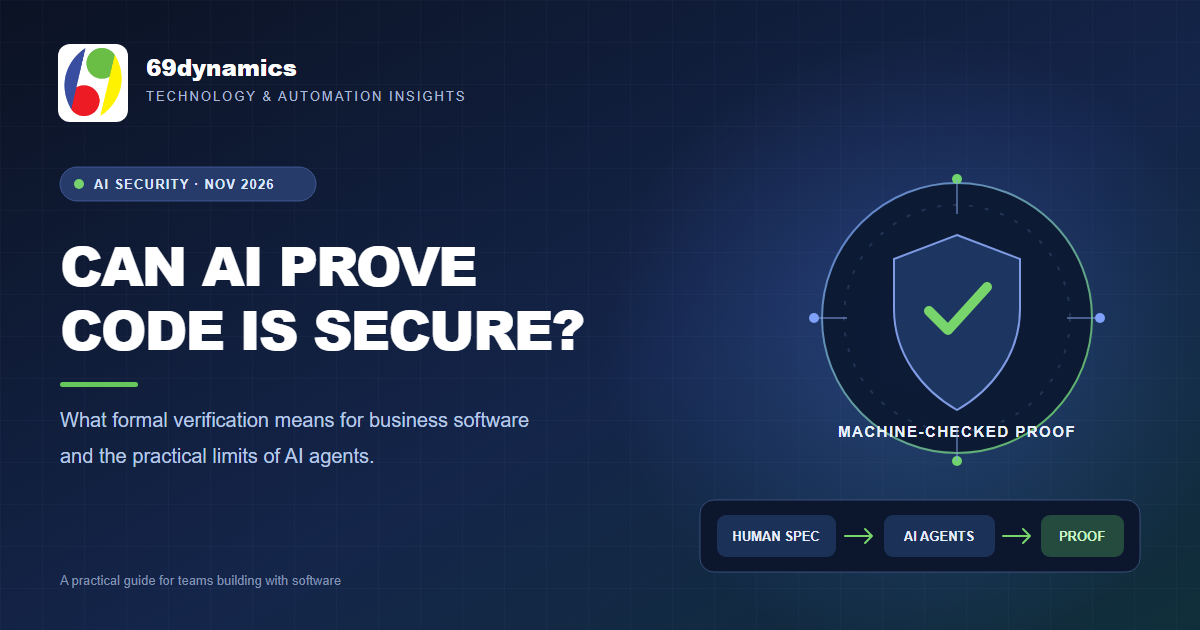
AI coding tools can generate software quickly. A harder question is whether the software actually meets the security requirements people depend on. A new research announcement from Google DeepMind offers a notable example of using AI agents to help answer that question with machine-checked proofs.
What was announced
On November 10, 2026, Google DeepMind described AlphaProof Code, a multi-agent framework used with human specialists to formally verify selected security properties in the compiled implementation of the Signal protocol. DeepMind says experts first defined and reviewed the specifications, then AI agents generated more than six million lines of Lean proof code. A trusted Lean checker validated the proofs, while human reviewers examined the areas the system flagged for attention. The team reported completing the work in four weeks.
This is a significant research result, but its scope matters. The proofs establish that the implementation meets the properties expressed in the approved specifications and modeled verification process. They do not prove that every part of Signal, every device, or every surrounding system is free from vulnerabilities. Formal verification is powerful precisely because it makes the assumptions and claims explicit.
Why business teams should care
Most organizations do not need a formal proof of every application. They can still adopt the useful discipline behind this work: write down critical requirements, automate checks that can be repeated, and give people clear evidence to review.
- Make requirements testable. Replace “the workflow must be secure” with concrete rules such as who can approve a payment, which records may be exported, and what should happen after a failed login.
- Automate repeatable checks. Use tests, access reviews, validation rules, backups, and monitoring to catch known failure modes before they become incidents.
- Keep a human accountable. AI can help create and inspect checks, but a qualified person should review the requirements, exceptions, and consequences of a failure.
- Start with high-impact paths. Prioritize customer data, payments, identity, and business-critical automations instead of trying to verify everything at once.
A practical next step
Choose one important workflow and document its expected inputs, permissions, outcomes, and failure behavior. Turn those expectations into automated checks and review the results whenever the workflow changes. That creates a safer foundation for using AI and automation without treating generated output as proof by itself.
At 69dynamics, we help businesses build and improve websites, software, and automation around clear operational needs. If you have a workflow that is repetitive, error-prone, or hard to audit, talk with our team about a practical first step.